

When is the best time to work out?
For about a decade I was a six in the morning lifter. Three or four mornings a week, an hour each time, before the day started. It's still my favorite way to train. The gym is empty, and it sets up the whole day.
I pulled my own training log to write this, and it turns out that person has been gone for a while.
The short answer
The best time to work out is whichever time you can actually repeat. The research comparing morning and evening training finds small differences that point in both directions, and they're much smaller than the difference between training twice a week and four times. If your schedule chooses for you, you haven't lost much. If your schedule chooses differently every week, that turns out to be survivable too.
What the research says about morning versus evening
The effect is small and depends on what you measure. A 2019 systematic review and meta-analysis published in Chronobiology International pooled eleven studies of moderate to good quality and found that strength increases were similar between morning and evening training groups, regardless of when strength was later tested.
Two things sit alongside that. You're genuinely stronger later in the day, which flatters evening testing. And the better-controlled work on muscle growth has found an advantage for training in the evening.
So if nothing constrains your choice, late afternoon is a reasonable default. That's a real finding and it's also close to useless for most people reading this, because something does constrain the choice.
When lifters actually train
Here's what RepCount lifters do rather than what a study protocol tells them to, across millions of tracked workouts.
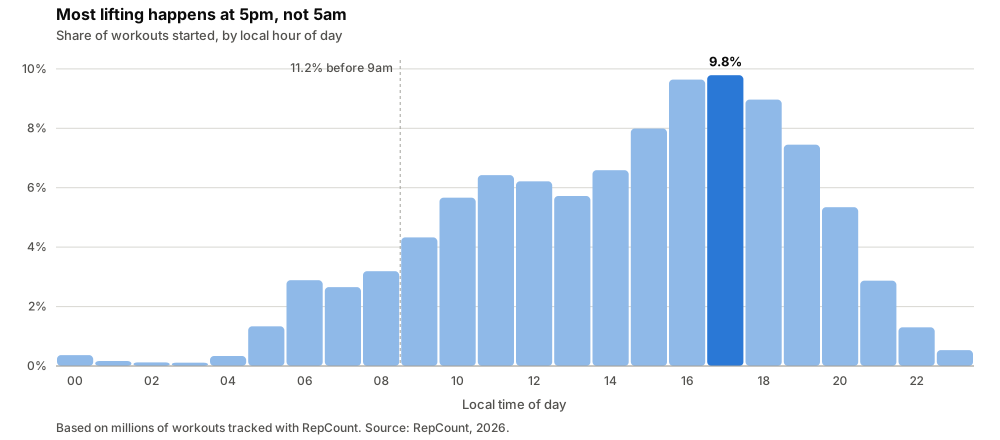
The peak is 17:00, which holds 9.8% of all sessions. Underneath that:
- 11.2% of workouts start before 9am. Morning training is a minority habit.
- Only 2.4% start before 6am. The 5am lifter is real and rare.
- 52.6% happen between 9am and 5pm, the block most people assume is unavailable.
Nobody arrived at 17:00 by reading a study. It's the hour work ends, and it beats physiology every time.
What happened to my own training time
I had two children, one in 2023 and one in 2026. I assumed the early mornings would be the casualty. They weren't.
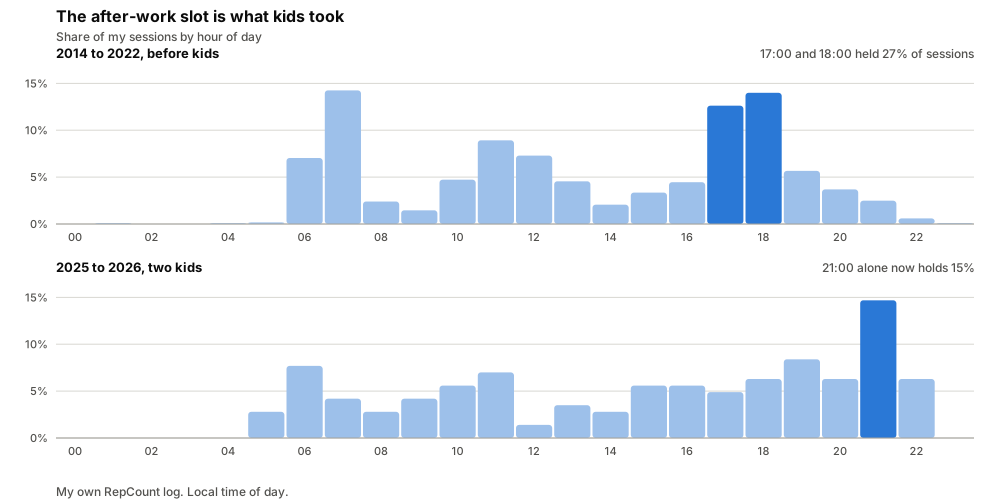
Before kids I trained at two times: first thing, or straight after work. 07:00 was my single biggest hour, and 17:00 and 18:00 together held 27% of my sessions.
The mornings mostly survived. Sessions before 9am went from 24% to 17%, a dent rather than a collapse. What disappeared was the after-work block, which is down from 27% to 11%.
Nine at night took its place. 21:00 was 2% of my training before kids and is 15% now, my biggest single hour.
That makes sense the moment you have children. Five to seven in the evening is dinner, bath and bedtime, and it is the least available hour of a parent's day. Early morning still works because nobody else is awake. Everything else gets pushed past bedtime.
What it looks like in practice: one session a week in a commercial gym, and everything else at home. The home setup is a good one, with dumbbells, kettlebells, a bench and a barbell. What it doesn't have is a rack, and the bar is a short one that won't take much past 110 kg. So the gym day is for barbell squats and anything else that needs a rack, and home covers the rest: heavy floor presses, Bulgarian split squats, kettlebell squats, front squats cleaned off the floor. Then there are the odd ones that fit nowhere in particular: pull-ups partway through a walk with the stroller, push-ups while the little one sleeps, a hundred kettlebell swings before anyone else is awake. Ideal? Probably not. You do what you can.
The sessions got shorter too, from a median of 52 minutes before my first child to 43 minutes after. What didn't happen is the thing I was afraid of. This year is running ahead of last year on total sessions, with a newborn in the house.
Does training time predict consistency?
Barely. I grouped every RepCount lifter by the time they usually train and measured how often they train.
| Usual training time | Workouts per month |
|---|---|
| Before 9am | 8.8 |
| 9am to noon | 8.1 |
| Noon to 5pm | 8.0 |
| After 5pm | 8.0 |
Morning lifters come out ahead by 0.8 sessions a month. That's one extra workout every five weeks.
There's a fair objection: people who can reliably train at 6am may already have unusually controlled lives, so the arrow could point either way. Both readings land in the same place. Moving your session to the morning buys you about one workout every five weeks at best, and only if the morning is a slot you can keep.
One number did move more. Lifters who usually train between noon and 5pm stick with it longest, keeping the habit going about two months longer than the evening group. Midday training tends to be attached to something already fixed, like a lunch break, and fixed things survive.
The only reason I know any of this
I would have told you, with complete confidence, that having kids cost me my early mornings. It's the obvious story. It's also wrong, and I only know it's wrong because thirteen years of sessions are written down. What actually went was the hour after work, and I'd never have guessed that.
Nobody remembers their own training accurately. You remember the sessions that felt significant and forget the ordinary ones, which are most of them.
That matters more than it sounds, because the thing this article keeps landing on is that the number of sessions beats the hour they happen at by a wide margin. Under one workout a month separates the best time of day from the worst. Four sessions a month against eight is a different training year entirely. And the count is exactly what you cannot judge from memory: a month where you trained six times and a month where you trained ten feel about the same while you're in them.
That's what a log is for. Not the hour. The count.
What to do if the time isn't yours to choose
Stop protecting the perfect slot. The gap between the best and worst time of day is under one session a month. The gap between two sessions a week and four is enormous. Trading a workout you'd have done for a workout at a better hour is a bad trade.
Pick a program that survives a missed session. Fixed training days suit plenty of people, and if Monday, Wednesday and Friday is what keeps you turning up, keep it. What matters is the cost of skipping one. I aim for full body about every other day, or two days on and one to two off on a half body split, which gives each muscle group several chances a week. Miss one and it's absorbed rather than fatal.
Take the slot attached to something already fixed. The longest-lasting habit in the data is the midday one, and midday is the slot most likely to be anchored to a lunch break rather than to willpower.
Expect to lose a slot, not the habit. The hour that stops working is usually the one with the most competing demands on it. Mine was straight after work. Losing it cost me nothing once something else took over, and my volume is climbing again.
RepCount is a free workout tracker for iOS and Android. It shows you what you lifted last session so you always know what to aim for, whatever time you get there.
Frequently asked questions
Is it better to work out in the morning or the evening?
For strength and muscle, the difference is small. A 2019 systematic review and meta-analysis in Chronobiology International pooled eleven studies and found strength increases were similar whether people trained in the morning or the evening. Evening has a small edge in some hypertrophy measures, and you're measurably stronger later in the day, but neither effect is big enough to outweigh which slot you can actually keep.
Do morning workouts make you more consistent?
Slightly. In RepCount's data, lifters whose typical session starts before 9am average 8.8 workouts per month against 8.0 for lifters who usually train after 5pm. That's a gap of under one session per month, so it's real but small. Training time isn't what makes people consistent.
What time do most people go to the gym?
Late afternoon. Across millions of workouts tracked with RepCount, 17:00 is the single most common start hour at 9.8% of all sessions. Only 11.2% of workouts begin before 9am and just 2.4% before 6am, so morning training is a minority habit rather than the norm.
Does it matter if I train at a different time every day?
Much less than you'd think. Nothing in RepCount's data suggests a moving schedule produces worse results than a fixed one. The number of sessions you complete matters far more than the hours they happen at.
Am I weaker if I train first thing in the morning?
A little, at first. Baseline strength is measurably higher in the evening for most people, and that gap narrows if you train early consistently, because the body adapts to the time it's regularly loaded. Logging your sessions in RepCount will show the morning numbers catching up over a few weeks.